Baker RES-Lab
Baker Resource Economics and Sustainability Lab
Lab Overview
Socioeconomic and environmental change are amplifying sustainability concerns globally. Land use change, water scarcity, and growing demands for natural resources are pressuring current infrastructure and market systems to unsustainable limits. Further, critical feedback loops exist between the climate system and managed resources. Addressing these resource management challenges will require solutions that span scientific disciplines — including engineering, economics, environmental science, and public policy. The wicked nature of sustainability challenges requires careful consideration of the interdependencies between human and natural systems to identify and evaluate potential solutions — be they infrastructure investments, policy interventions, or alternative management strategies.
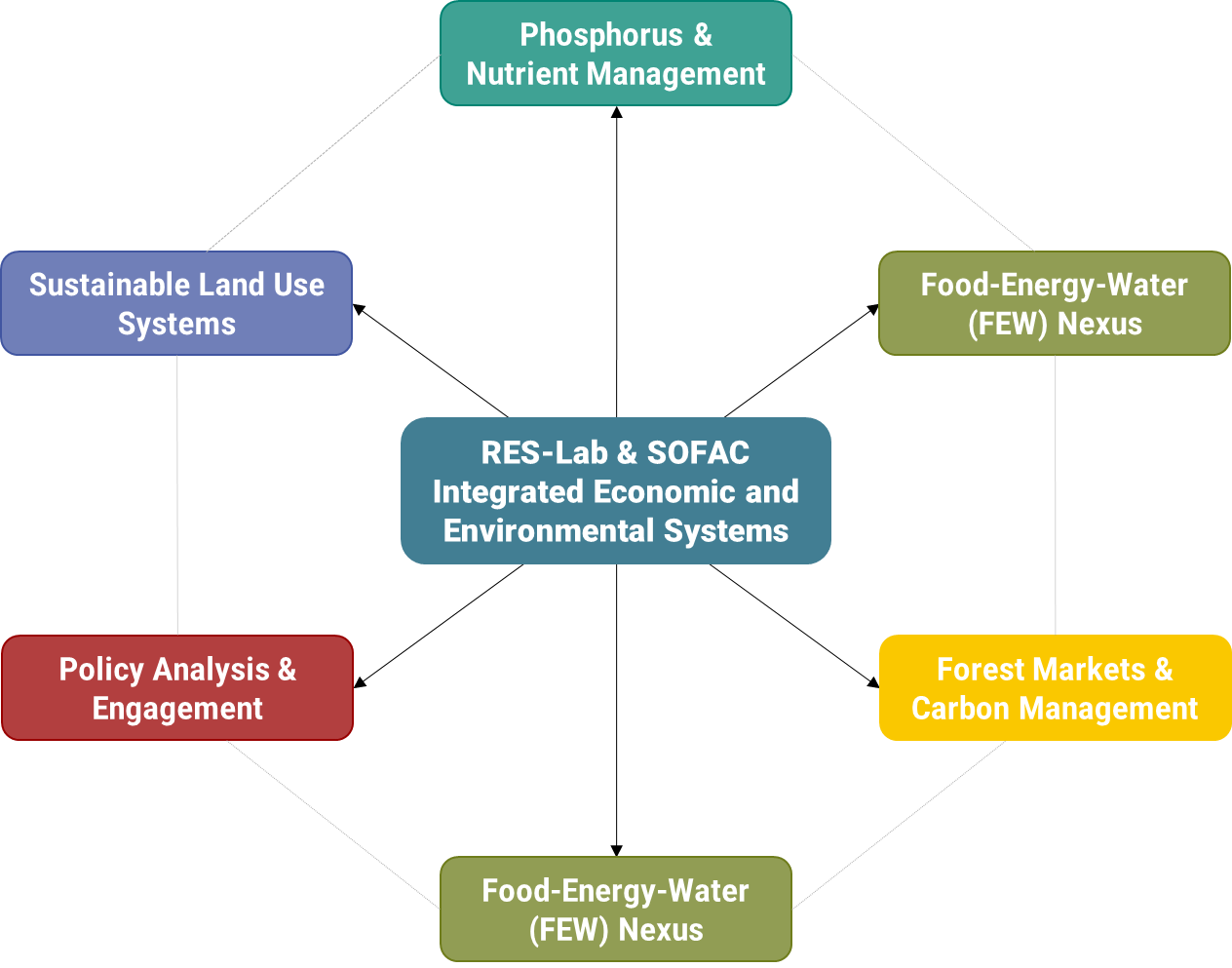
The Baker Resource Economics and Sustainability Lab (RES-Lab) specializes in systems thinking and integrated economic modeling to address critical societal challenges. The RES-Lab, led by Dr. Justin Baker, offers training and collaboration opportunities to students and postdocs with an interest in integrated natural and human systems, with some research areas summarized in the following figure.
2025 Highlights
Check out our list of accomplishments and outputs in 2025 here!
RECENT BLOG POSTS
All Posts
What Happens to Phosphorus, Sulfur, and LNG Supply Chains When Global Trade Networks are Disrupted?
Read more
Systems Research Tools for Systemic Investing: Bioeconomic Models
Read more

Could Critical Mineral Designation for Phosphate Rock Ease Market Tension and Support Sustainable Phosphorus Solutions?
Read more

How Much Wood Is Out There? It Depends on the Method
Read more

Determining optimal locations for targeted tree-planting on national and city-level scales.
Read more
- Dhungel, Baker, Henderson, and cool. (2026). Acorn review: Biochar and its applications in US forestry. Forest Ecology and Management.
- Puls et al. (2026). Climate effects of management intensity and rotation length for planted pine systems. Mitigation and Adaptation Strategies for Global Change.
- Wang, J., Elser, J., Muenich, R., Baker, J., Jones, J., and Hou, D. (2026). Opportunities to strengthen US phosphorus supply resilience through circular pathways. Environmental Sciences.
Projects
- Science and Technologies for Phosphorus Sustainability (STEPS). National Science Foundation. 2021-2026. (Co-PI, Research Theme Co-lead)
- Food, Agriculture, Biodiversity, Land Use, and Energy (FABLE) Consortium. UN Sustainable Development Solutions Network. 2018-present. (US Team Co-Lead)
- Recent policy brief on global biodiversity targets
- 2020 FABLE report and U.S. chapter on sustainable land use pathways
- Southern Forest Resource Assessment Consortium (SOFAC) (Director)
- SOFAC develops market models and forward-looking resource assessments of the southern U.S. forest sector
- Recent work on Hurricane Michael and forest markets
- Accelerated Genetic Improvement of Fir through Sequencing, Economics, Extension and Diagnostics (A GIFT SEED). 2024-2028.
- Modeling growth response of loblolly pine and economic returns from nutrient additions. USDA, McIntire-Stennis Program. 2021-2024. (Co-PI
- U.S.-China Food-Energy-Water Feedback Mechanism: A Comparative Study of China’s Jing-Jin-Ji Region and California’s Central Valley. National Science Foundation. 2021-2025. (PI)
- A multi-scale decision support tool to quantify forest benefits on water quantity and quality in the Southern United States. 2020-2023. (Co-PI). Publication examples here and here.
Research
- Forest bioenergy policy and the carbon neutrality debate
- Water resource management and development (Morgan et al., 2021)
- RTI Grand Challenge: Building Resilience in Food, Energy, and Water Systems. RTI International. 2020-2021.
- Hydro-economic modeling to identify spatial hotspots for irrigation expansion in Guatemala
- Energy poverty and low-carbon development tradeoffs in Guatemala