Members
RES-Lab students, scholars, and affiliates
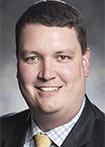
Dr. Justin Baker (CV) — Hello! Welcome to the Baker Resource Economics and Sustainability Lab (RES-Lab) website. My name is Justin Baker and I am an Associate Professor in the Dept. of Forestry and Environmental Resources at NC State University. I teach a course on Natural Resource Management (NR 400/500), Seminar on Forest Carbon Modeling (NR 610, Special Topics), and lead the department seminar series (FOR 801) for some semesters. Before joining the faculty at NCSU, I spent almost a decade at the research institution RTI International, with stops at Duke University as well. I completed my graduate studies in Agricultural and Applied Economics at Texas Tech and Texas A&M Universities.
Research in the RES-Lab covers a wide range of topics, including forestry and land use modeling, integrated water resource management and hydro-economics, global change analysis, interactions between trade policy and the environment, and energy policy. I am the Director of the Southern Forest Resource Assessment Consortium (SOFAC), which supports research and market modeling efforts in the southern U.S. forest sector. I collaborate holds a guest researcher affiliation with the International Institute for Applied Systems Analysis (IIASA), is a faculty affiliate with the Center for Environmental and Resource Economic Policy (CEnREP) and Duke University’s Energy Access Project (EAP), and maintains collaborations with various government stakeholders, NGOs, and academic institutions.
Growing up in Lubbock, Texas, I became interested in natural resource management and sustainability issues early on in my career. West Texas is an agriculture- and energy-dependent regional economy, and like a lot of semi-arid environments, the region faces water scarcity concerns that will be amplified by climate change in the coming decades. Addressing resource scarcity, or natural resource management challenges broadly, requires analysis of tradeoffs and (often) a long-term perspective. Economics and dynamic modeling of integrated economic and environmental systems offers a path for quantifying tradeoffs of policy or management alternatives, and for identifying solutions that are resilient to global change.
I’m passionate about higher education and helping the next generation of scientists and resource managers develop the skills they need to thrive in an increasingly complex world. Here is an intro to some of the amazing students and scholars in the RES Lab that are actively working to address some of the world’s most pressing challenges through research and engagement:
Postdoctoral Scholars and Fellows

Dr. Madisen Fuller (CV) is a Postdoctoral Scholar who completed her PhD in Forestry with a minor in Public Administration at NC State. Dr. Fuller’s research focus is on forest carbon modeling, carbon markets, and policy analysis. She is passionate about improving economic carbon modeling to integrate economic, environmental, social, and policy interactions in a forestry context. She is involved in new economic research and modeling on urban tree planting in the Southeastern U.S., using her city of residence, Durham, North Carolina, as a case study.

Dr. Chanheung Cho (CV) is a Postdoctoral Scholar in the RES-Lab who recently completed a PhD in Economics at NC State. Dr. Cho’s research primarily centers on the application of dynamic optimization methods to address environmental and resource management problems, with a particular focus on structural and observational uncertainties. He is also a STEPS Scholar and CEnREP postdoc affiliate.

Dr. Gaurav Dhungel (CV) is an ORISE Research Fellow in the Forest Economics and Policy Unit of the USDA Forest Service and an affiliate of the RES-Lab. He earned his Ph.D. from NCSU, where he worked with the Southern Forest Resource Assessment Consortium and the RES-Lab. He holds an M.S. in Forestry and Natural Resources from the University of Kentucky. His research focuses on “oakonomics”—the economics of oak forests across the eastern United States—and applies economic theory and forest sector modeling to quantify landscape-scale hardwood dynamics and management–market tradeoffs.
Graduate Students

Olakunle Sodiya is a Forestry and Environmental Resources Ph.D. student. He received a B.S. degree in Forestry and Wildlife Management from the Federal University of Agriculture Abeokuta, Nigeria. He studied Resource Economics and Management at West Virginia University and later received an M.S. degree in Forestry and Environmental Resources at NCSU. Ola’s work focuses on understanding how global climate change and climate-oriented policy changes could impact forest product market, forest resources utilization, investment, and market outcomes in the US. Ola is currently a Global Change Fellow with the Southeast Climate Adaptation Sciences Center (SECASC).

Nathan Schunk (CV) is a 3rd year PhD student in the Baker Resource Economics and Sustainability Lab (RES-LAB) focused on the interactions between land use, nutrient dynamics, and environmental change across agricultural and natural systems. He is a current STEPS Scholar, conducting research on phosphorus dynamics and management, with particular emphasis on implications for water quality, ecosystem services, and food security. He is also a former 2022–2023 Global Change Research Fellow at the Southeast Climate Adaptation Science Center (SECASC). His work integrates geospatial analysis, system-dynamics modeling, and interdisciplinary data sources to evaluate how landscape and management decisions influence environmental outcomes from regional to global scales. He has contributed to projects supported by NASA, NSF, and NOAA, including research on extreme flooding and watershed responses.
Richard Manner (CV)
Matthew Clutter (CV)
.
Affiliates/ Research Staff

Clarisse Owens (CV) holds an M.S. of Natural Resources from North Carolina State University, where she was named a 2025 Center for Environmental Farming Systems Fellow for her work on land retention. She currently supports economic development projects and policy analysis related to agricultural systems with the Baker Resource Economics and Sustainability Lab. She earned her bachelor’s degree from the University of Michigan in Organizational Studies, and her professional background in food systems continues to shape her questions, interests, and goals.
Former Graduate Students and Lab Affiliates
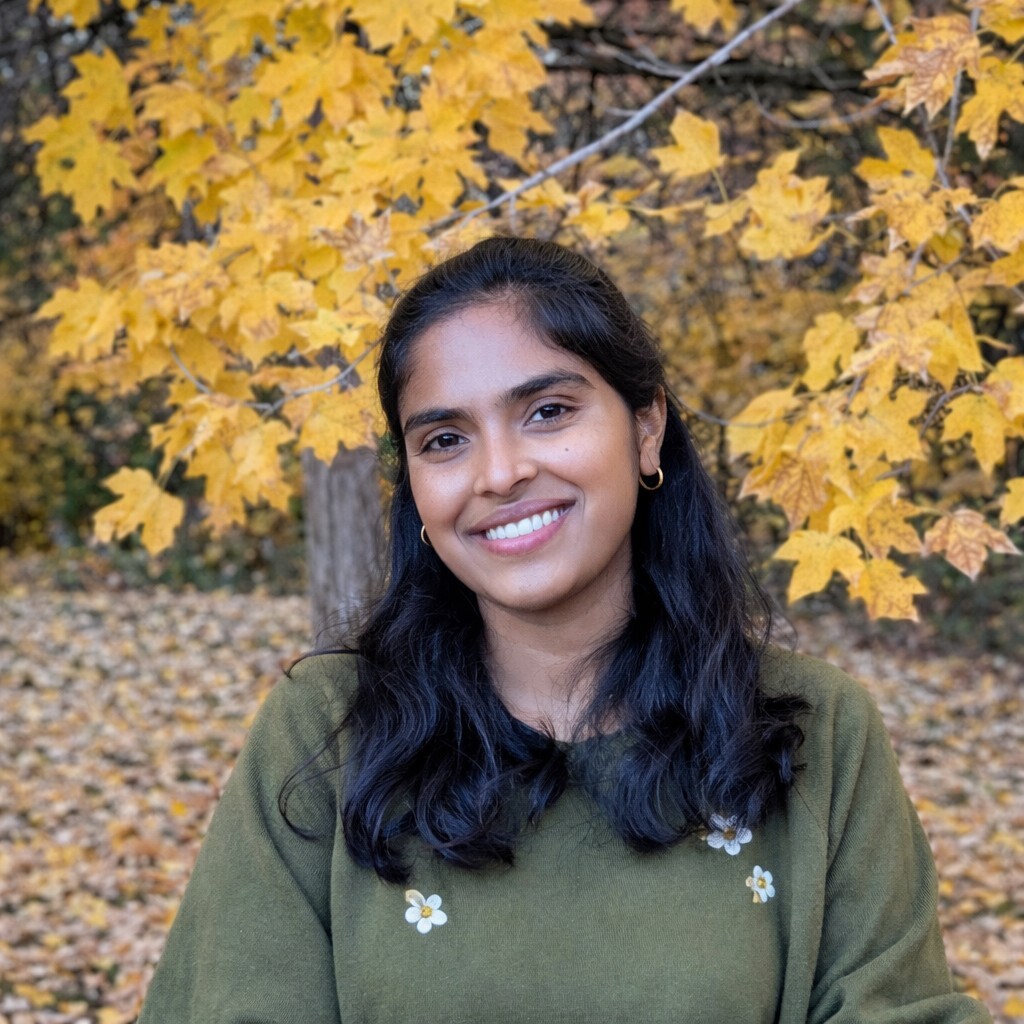
Dr. Manaswini Ganjam (CV) works on ecosystem modeling and geospatial data science focused on forest carbon dynamics, disturbance processes, and climate–ecosystem interactions. Her research integrates process-based ecosystem models, long-term ecological datasets, and spatial analysis to examine controls on carbon cycling across forest systems. She is currently a postdoctoral researcher at the University of Missouri. Her work involves analysis of large geospatial and climate datasets to study fire–vegetation interactions, forest age structure, and ecosystem carbon fluxes.

Dr. Arpita Nehra is a former Postdoctoral Researcher in the RES-Lab. She supported an interdisciplinary project to understand and quantify the linkages between water quality, land use change, and water treatment costs. Dr. Nehra is a natural resource economist interested in using economic theory and modeling to facilitate policies revolving around natural resources and land use. Her research has centered around the application of econometric and general equilibrium tools to water economics, specifically, urban water and water trade in the Western US and India. She is currently a postdoctoral scholar at the University of Minnesota.

Dr. Ziqian Gong was a Postdoctoral Research Scholar in the RES-Lab. He earned his Ph.D. in Applied Economics from The Ohio State University in 2022. His research focuses on environmental and resource economics, climate change, food-energy-water nexus, computable general equilibrium (CGE) model, and decision-making under uncertainty. His previous research includes building a CGE model to analyze environmental sustainability and individual well-being resulting from shifts in the Great Lakes area’s complex economic and environmental systems. Dr. Gong is currently a Senior Economist at RTI International.

Shiyue Yao is a third-year doctoral student in Applied Economics at NC State University. Shiyue’s research interests include environmental and resource economics, climate economics, and applied econometrics. Her recent research covers environmental policy impact evaluation, and integrated assessment modeling in climate change mitigation and adaptation.

Dr. Iván Raigosa-García is a former Ph.D. student in Forestry who earned my undergraduate degree in Forestry Engineering from the National University of Colombia, and an MS in Forest Science from the University of Florida. His research focuses on precision silviculture in the southern US. We use soil data, LiDAR, historical growth, and yield data to model loblolly pine growth and response to different management regimes, as well as the return on investment to silvicultural and carbon management strategies. He is currently at postdoc in the Plantation Management Research Cooperative (PMRC) at the University of Georgia.

Josephine Geraghty is a former MS student in Natural Resources and a scholar in the STEPS Center. She also holds a Bachelor of Science in sustainability science from Furman University. As a STEPS scholar and Director’s Fellow, her research focused on potential pathways to sustainable phosphorus futures. She also conducted empirical research on communication and public outreach efforts in the Center. Ms. Geraghty is currently an Environmental Engineer at WSP.

Thu Ho completed her MS student in Forestry in 2023. She is from Ho Chi Minh City, Vietnam and completed her bachelor’s degree in Economics and Environmental Studies at Augustana College, Illinois. Her research interests involve coupled natural-human systems and developing economic models to help identify policy interventions that are resilient to socio-economic and environmental changes. She was a member of the inaugural graduate student cohort for the STEPS Center. Her MS evaluated drivers of fertilizer price volatility, developed future price volatility projections, and applied complex network analysis to study the evolution of phosphorus and nitrogen fertilizer trade networks.

Chris Wade is a former graduate student in the College of Natural Resources at NC State in the RES-Lab and received a master’s degree in forestry and natural resource economics from Virginia Tech. He is currently an senior natural resource economist and manager at RTI international. His research focuses on applying dynamic, spatially explicit modeling frameworks to assess tradeoffs in coupled human-environmental systems. His research covers an array of topics including forestry, land use, climate change mitigation, groundwater management, and coastal resources. Chris was a member of the 2022 Young Scientist’s Summer Program at IIASA and a STEPS Scholar at NC State.

Alexandra Hayes completed a Master’s in Natural Resources in 2023. Her thesis work focused on drivers of food security in California’s Central Valley — part of an NSF-funded project on food-energy-water nexus sustainability. She received her B.A. in economics and sustainable development from Columbia University in 2021. She is broadly interested in examining the implications of various policy pathways and environmental change in the food-energy-water nexus. Allie was a member of the inaugural Climate Leaders Program where she interned at RTI International. Allie is currently an Energy Trading Analyst at Brookfield Renewable U.S.
